
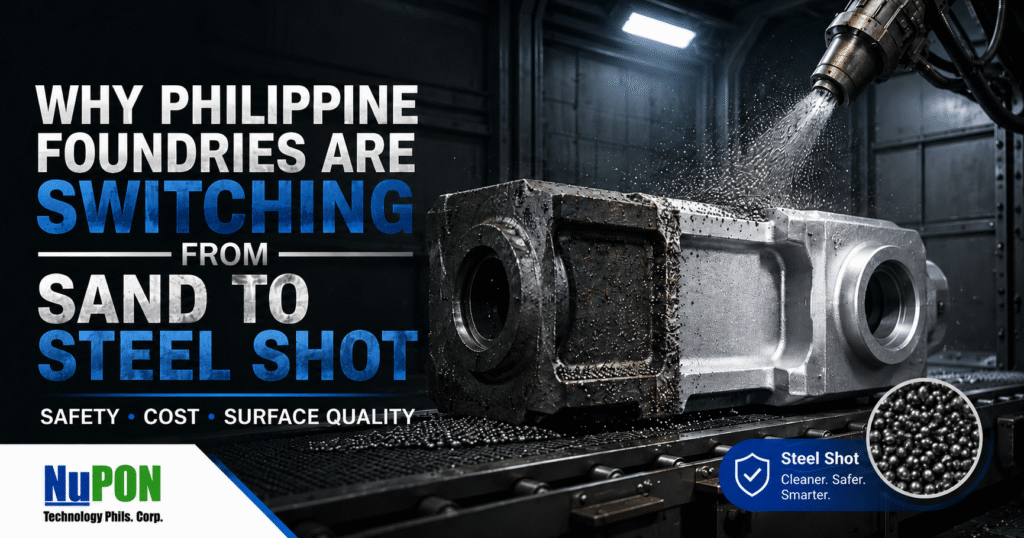
Philippine foundries and forging plants are increasingly replacing silica sand with steel shot and steel grit — and the shift is driven by three forces: worker safety regulations, long-run cost economics, and tighter surface quality standards demanded by downstream coating and painting processes. This guide explains why the switch is happening, what the technical and financial data show, and which grades apply to heavy-duty large casting and forging applications.
Steel Shot vs Sand Blasting Philippines: The Safety, Cost and Quality Data Driving the Switch
Why Philippine Foundries and Forging Plants Are Switching from Sand to Steel Shot
Picture a large grey-iron casting fresh out of the mold — rough, dark, encrusted with bonded foundry sand and oxidation scale. Before it can be machined, inspected, painted, or shipped, that surface has to be clean. In Philippine foundries for decades, the tool of choice was silica sand. Cheap, available, familiar.
But “cheap” is a calculation that changes dramatically once you add up what sand actually costs — in worker health, in abrasive consumption, in surface consistency, and in the disposal fees that follow every single blast. Across CALABARZON’s growing industrial corridor and beyond, procurement managers and plant engineers are running those numbers and arriving at the same conclusion: steel shot and steel grit are not just better for their workers. They are better for the bottom line.
Here is what the data — from OSHA, ISO, and the Philippine Statistics Authority — actually shows.
Philippine Manufacturing Is at an Inflection Point
CALABARZON is no longer simply the country’s largest industrial region — it is increasingly the benchmark for how Philippine manufacturing competes globally. According to the Philippine Statistics Authority, CALABARZON’s economy grew 5.1% in 2025, generating a Gross Regional Domestic Product of PHP 3.436 trillion — accounting for 14.8% of the national economy. Manufacturing alone made up more than 40% of the regional output, contributing 1.9 percentage points to overall growth.[1]
The region’s appetite for investment reflects this trajectory. CALABARZON and Central Luzon together accounted for nearly two-thirds of total approved foreign investment pledges in 2025 — roughly PHP 171.2 billion worth of commitments concentrated in the country’s most active industrial corridors.[2]
That growth creates a specific pressure point that procurement managers know intimately: the surface preparation bottleneck. Every steel part produced in this corridor — whether a casting from a Pampanga foundry, a structural beam from a Laguna fabricator, or a heat-treated forging from a Batangas parts manufacturer — requires surface cleaning before it can be coated, welded, assembled, or shipped. The abrasive media used in that step is not a peripheral supply; it is a continuous production input that determines speed, quality, and worker safety every single shift.
Why Silica Sand Is a Health Liability, Not Just a Supply Item
The occupational safety case against silica sand in blasting operations is not speculative. It is documented extensively by the world’s leading occupational health authorities, and it applies directly to Philippine facilities operating blast rooms and open-air blasting today.
The U.S. Occupational Safety and Health Administration (OSHA) is unequivocal on the mechanism: when silica sand fractures under blasting impact, it generates respirable crystalline silica dust at concentrations that can be hundreds or thousands of times above safe occupational exposure limits.[3] Workers who inhale these particles develop silicosis — described by OSHA as “a stiffening and scarring of the lungs which can result in death.”[4]
Silicosis is progressive, irreversible, and incurable. But it is not the only risk. NIOSH (National Institute for Occupational Safety and Health) links crystalline silica exposure to:
- Lung cancer (classified by IARC as a Group 1 carcinogen in individuals with silicosis)
- Chronic Obstructive Pulmonary Disease (COPD)
- Chronic kidney failure
- Elevated susceptibility to tuberculosis — a particularly relevant comorbidity in the Philippine context
- Systemic autoimmune diseases including scleroderma and rheumatoid arthritis[5]
NIOSH’s position, codified in NIOSH Alert 92-102, is not merely cautionary — it is a direct recommendation to stop using silica sand for blasting entirely and replace it with safer alternatives.[6] The European Union went further: the EU banned silica sand for abrasive blast cleaning in 1966.[7]
Critically, the OSHA Factsheet on abrasive blasting materials directly addresses the alternative: “Steel grit and shot have less potential to cause lung damage” than silica sand.[8] This is not marketing language. It is the official position of a regulatory body with jurisdiction over the world’s largest industrial economy.
For a Philippine plant running daily blasting operations, the calculus is straightforward: every shift on silica sand is a DOLE compliance exposure and a long-term workers’ compensation liability. The switch to steel abrasives is not just an operational upgrade — it is a risk management decision.
What Heavy-Grade Steel Abrasives Actually Do — and Why Grade Matters
Not all steel abrasives are the same, and the grade selection for foundry and forging applications is precise. Understanding the distinction between steel shot and steel grit — and knowing which grade handles which job — is where operational efficiency is won or lost.
Steel Shot vs. Steel Grit: The Functional Difference
Steel shot is spherical. When it impacts a surface, it creates a peened, dimpled finish — consistent, smooth, and excellent for removing sand and light scale without creating a deep anchor profile. Shot peening with steel shot actually compresses the surface of metal components, increasing fatigue resistance in applications like automotive springs, gears, and crankshafts.
Steel grit is angular — manufactured by crushing and re-heat-treating steel shot into sharp-edged particles. Angular grit cuts into the surface aggressively, creating a rough anchor profile that coating and paint adhesion depends on. According to ISO 8503, grit creates a “G-type” (deeply scored) profile versus shot’s “S-type” (rounded peak) profile.[9]
For large castings and forgings specifically, both types serve distinct sequential roles in the production process.
The Heavy-Grade Tier: S780, S660, G10, G12
The coarsest grades in NuPON’s range — S780/SS2.5 and S660/SS2.0 for steel shot, G10/SG2.5 and G12/SG2.0 for steel grit — are designed for the most demanding descaling and sand removal scenarios. Per W Abrasives (Winoa, one of the world’s leading steel abrasive manufacturers), these heavy grades are the correct specification for:
Blasting of heavy steel castings, removal of tough heavy scale, and removal of scale from large billets, slabs, and other large rolled products — including pipes, sections, plates, fittings, and wire drawn or rolled stock, before or after heat treatment.[10]
Rosler, a leading blast equipment manufacturer, describes the operational context clearly: “Shot blasting is an essential part of most forge and foundry operations and has been used since the late 1800s. This specialized surface finishing process throws small metal pellets onto the surface of a workpiece at incredibly high speeds, ranging from 200 to 800 feet per second.”[11]
At those velocities, a 2.5mm steel shot or grit particle carries sufficient kinetic energy to dislodge even vigorously bonded foundry sand or post-forging scale from large cast iron or malleable iron components — the task that defines whether a casting line runs on schedule or stalls at the cleaning stage.
Surface Preparation Standards: The Non-Negotiable Floor
Philippine manufacturers supplying to international customers or operating under ISO quality systems face a hard technical requirement at the surface preparation stage. The governing standard is ISO 8501-1, which classifies blast cleaning grades from Sa 1 (brush-off) to Sa 3 (white metal).
For industrial anti-corrosion coating — the coating specification applied to the vast majority of structural steel, pipes, cast parts, and fabricated assemblies — ISO 12944 mandates a minimum of Sa 2½: “very thorough blast cleaning,” equivalent to SSPC-SP 10 Near-White Metal in the North American standard framework.[12]
Sa 2½ means at least 95% of the blasted surface must show no visible mill scale, rust, paint, or other contaminants — only faint shadows or stains are permitted over the remaining 5%.[13] Achieving this consistently with silica sand is difficult: the sand’s irregular particle size distribution makes surface profile control unreliable. Steel shot and steel grit, manufactured to SAE J444 (shot) and SAE J827 (grit) standards with narrow hardness ranges, produce consistent, repeatable surface profiles that meet and hold Sa 2½ specifications across production runs.[10]
The Real Cost of Sand vs. Steel Shot: Why Cheap Gets Expensive Fast
The objection that typically keeps Philippine procurement managers on silica sand — or copper slag, or other single-use alternatives — is the upfront price. Steel shot costs more per kilogram than sand. This is true. But it is the wrong comparison.
The correct metric for abrasive media is cost per effective blasting cycle: the purchase price divided by the number of times the media can be reused before it must be replaced. On this metric, the economics reverse completely.
According to industry cost analysis published in 2026, steel shot and steel grit in a properly maintained closed-loop reclaim system achieve 200 to 500 reuse cycles, with high-quality steel grit reaching up to 2,000 cycles under optimal operating conditions. Single-use media — coal slag, copper slag, silica sand — achieve exactly one cycle before disposal.[14]
The cost-per-cycle comparison, using representative 2026 market pricing:
| Media Type | Reuse Cycles | Cost per Effective Cycle | Disposal Classification |
|---|---|---|---|
| Steel shot/steel grit | 200–2,000+ | ~$0.005–$0.007/kg per cycle | Non-hazardous metal |
| Coal slag | 1 | Full purchase price per cycle | Potentially hazardous (arsenic, cadmium) |
| Copper slag | 1 | Full purchase price per cycle | Potential lung damage risk (OSHA) |
| Silica sand | 1 | Full purchase price per cycle | Hazardous if from leaded-paint work |
One published cost analysis puts this in stark operational terms: steel grit in an enclosed blast room costs approximately $0.78 per square meter of surface blasted. Coal slag in a once-through open setup costs approximately $53.80 per square meter — a 69-fold difference.[15]
Steel abrasives are 10 to 30 times cheaper per effective blasting cycle than single-use alternatives, according to 2026 abrasive media cost research.[16]
There is also the disposal dimension. Single-use abrasives generate large volumes of spent blast waste with every shift. Depending on the base metal being blasted and the contaminants involved, disposal can run PHP 2,000–18,000 per metric ton in hazardous waste classification scenarios. Steel abrasive waste, by contrast, is typically non-hazardous and generates far lower volumes over time due to recyclability.[14]
For a CALABARZON foundry blasting a continuous production of large castings across two shifts daily, the math over 12 months favors steel abrasives decisively — even after accounting for the capital cost of blast room equipment upgrades.
A Growing Global Market — with Southeast Asia at the Center
The shift from single-use media to recyclable steel abrasives is not a localized Philippine trend. It reflects a global industrial reckoning that Philippine manufacturers can either lead or follow.
According to Grand View Research, the global metal abrasives market was valued at USD 6.7 billion in 2025 and is projected to grow to USD 10.1 billion by 2033 at a CAGR of 5.1%.[17] The steel segment dominates — accounting for 89.9% of the metal abrasives market by material — driven by casting, forging, aluminum die casting, and automotive component surface preparation.[17] Asia Pacific holds the largest regional share at 56% of global metal abrasives revenue in 2025, reflecting the concentration of heavy manufacturing in this part of the world.[17]
That market concentration matters for Philippine buyers. ASEAN-region steel abrasives supply has deepened significantly as demand from Philippine, Vietnamese, Indonesian, and Thai industrial corridors has grown. For Philippine procurement managers, this means more supplier competition, better pricing, and — for those who source locally — no import waiting time.
The Import Lead Time Problem Philippine Foundries Cannot Ignore
There is a supply chain dimension to the sand-to-steel transition that does not appear in global market reports but is acutely felt in Philippine plant operations: import lead time.
A foundry running daily blast operations has no tolerance for supply disruptions. When an imported abrasive batch is delayed — whether by port congestion, customs clearance backlogs, or shipping schedule changes — production stops. Large castings queue up. Downstream machining and finishing lines wait. The cost of that delay is not the price of the abrasive: it is the cost of idle capacity across an entire production chain.
This is the operational reality that has driven Philippine industrial buyers toward locally-stocked suppliers, particularly for consumables like steel abrasives where the cost of stockout is disproportionate to the cost of the media itself.
For CALABARZON-based manufacturers specifically, the proximity advantage is significant. A foundry or forging plant in Biñan, Cabuyao, or Santa Rosa can receive steel abrasive replenishment within hours from a local warehouse — compared to the four-to-eight week import cycle that comes with relying on overseas suppliers.
Selecting the Right Grade: A Practical Guide for Philippine Procurement
Grade selection for steel abrasives is not complicated, but it does require matching the abrasive to the specific workpiece and surface requirement. The following framework covers the most common scenarios in Philippine foundry and forging applications.
For Large Castings (Grey Iron, Malleable Iron, Heavy Steel Castings)
Recommended: S780/SS2.5 (steel shot) or G10/SG2.5 (steel grit)
Use S780 shot where sand removal is the primary goal and a smooth, peened finish is acceptable for subsequent machining. Use G10 grit where an aggressive anchor profile is needed before painting or coating. Both grades carry the impact mass required to dislodge bonded foundry sand from large-format castings in a single blast cycle.
For Large Forged Products (Slabs, Billets, Pipes, Wire Rod)
Recommended: S660/SS2.0 (steel shot) or G12/SG2.0 (steel grit)
Post-heat-treatment scale on forged products is typically thicker and more adherent than foundry sand. G12 grit’s angular particles cut under the scale layer, lifting it cleanly. S660 shot handles lighter scale and produces a consistent surface for dimensional inspection. These grades are also the standard specification for roller conveyor blast lines used in pipe and plate pretreatment.
For Medium Castings, Structural Steel, and Pre-Paint Preparation
Recommended: S550/SS1.7 through S330/SS1.0 (shot) or G16/SG1.4 through G25/SG1.0 (grit)
This mid-range covers the largest volume of Philippine industrial blasting applications — from steel structure fabricators cleaning I-beams before primer to medium-sized foundries cleaning automotive castings. G18 and G25 grits are particularly common for achieving Sa 2½ and Sa 3 profiles on structural steel per ISO 8501-1 requirements.
For Fine Surface Work (Stainless Steel, Non-Ferrous, Dacromet Coating Prep)
Recommended: S170–S110/SS0.5–SS0.3 (shot) or G50–G120/SG0.4–SG0.2 (grit)
These fine grades are used for thin-gauge stainless steel plates, non-ferrous alloy components (aluminium, copper, zinc), and surface preparation before specialty coatings like dacromet, which requires an extremely fine, clean profile to achieve proper adhesion.
The Bottom Line for Philippine Foundries and Forging Plants
The data makes a consistent argument across every dimension of the sand-to-steel transition:
- Safety: OSHA and NIOSH confirm steel abrasives carry significantly lower lung damage risk than silica sand. Silicosis is incurable; preventing it is the only option.
- Cost: Steel shot and grit are 10–30x cheaper per blasting cycle in closed-loop reclaim systems. The true cost of sand — including disposal, PPE, and health liability — is far higher than its purchase price suggests.
- Quality: Steel abrasives produce consistent, repeatable surface profiles that meet ISO 8501-1 Sa 2½ requirements and satisfy downstream coating specifications that sand cannot reliably achieve.
- Supply reliability: Locally stocked steel abrasives eliminate the import lead time risk that a single supply disruption makes visible in painful operational terms.
CALABARZON’s manufacturing sector is growing at 5.1% annually and attracting billions in foreign investment. The plants in that corridor that compete for precision manufacturing orders — automotive OEMs, export-grade fabricators, international-spec foundries — cannot afford surface preparation processes that leave quality, safety, or supply reliability to chance.
Steel shot and steel grit are not a premium choice over sand. They are the technically correct choice. The question for Philippine procurement managers is no longer whether to make the switch — it is when, and with which supplier.
Ready to make the switch to steel abrasives?
NuPON Technology Phils. Corp. supplies ISO 9001:2015 certified steel shot and steel grit across the Philippines — locally stocked in Santa Rosa, Laguna, with nationwide delivery. Available in the full grade range from S110/G120 to S780/G10.