
CONTROL THE IMPACT
A complete guide to media shape, size, hardness, equipment compatibility, surface profile, and application selection—so every blast cycle produces the result your operation actually needs.
In abrasive blasting, the media is not simply a consumable poured into a machine. It is one of the most important process variables controlling cleaning speed, surface texture, equipment wear, media consumption, part condition, and the quality of the next manufacturing step.
Choose the wrong abrasive and a blast machine may still appear to be working. Parts will move through the system. Media will strike the surface. Scale or contamination may even disappear.
But beneath that apparent progress, the operation may be cleaning too slowly, producing the wrong surface profile, consuming too much abrasive, wearing critical machine components, or creating inconsistent results from one batch to the next.
Choose the correct abrasive and the entire blasting process becomes more controlled, repeatable, and productive.
The real question is not, “Which is better—steel shot or steel grit?”
The correct question is: “Which abrasive will create the required action on this material, in this machine, at the necessary production rate, without damaging the part or wasting resources?”
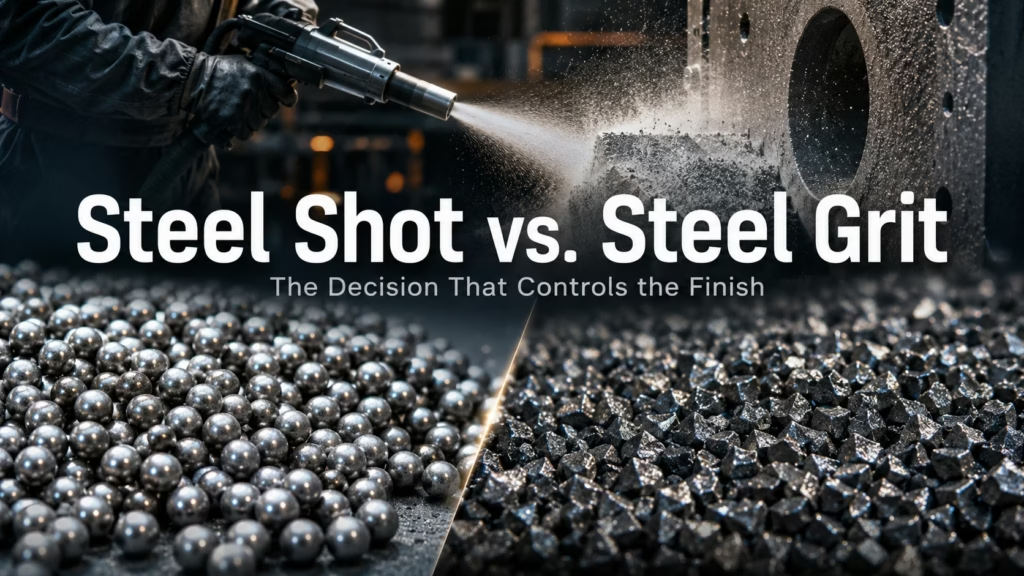
Steel shot and steel grit are both high-density metallic blasting abrasives, but they behave differently at impact. One primarily hammers and peens. The other primarily cuts and etches.
Understanding that difference is the foundation of intelligent abrasive selection.
The Essential Difference Between Steel Shot and Steel Grit
| Factor | Steel Shot | Steel Grit |
|---|---|---|
| Particle shape | Spherical or nearly spherical | Angular, with edges and corners |
| Primary action | Impacting, hammering, and peening | Cutting, scraping, and etching |
| Typical surface result | More uniform and comparatively smoother | Rougher, sharper, and more textured |
| Common objective | Cleaning, desanding, descaling, and peening | Aggressive scale removal and surface profiling |
| Common equipment | Frequently used in wheel-blast systems | Frequently used in air-blast systems; selected grades may also be used in wheel equipment |
| Main advantage | Coverage and controlled impact | Cutting power and profile generation |
Steel shot is generally selected when controlled impact, cleaning uniformity, or peening is the priority. Steel grit is generally selected when aggressive cutting and a pronounced surface profile are required.
Neither product is universally superior. Each is engineered to perform a different function.
What Actually Happens During Abrasive Blasting?
A blasting machine accelerates abrasive particles toward a workpiece using either a high-speed rotating wheel or compressed air. When each particle strikes the surface, its kinetic energy is transferred into the workpiece and the material attached to it.
Repeated abrasive impact can remove:
- Foundry sand
- Mill scale
- Heat-treatment scale
- Rust and oxide
- Old coatings
- Surface contamination
- Loose manufacturing residue
Abrasive blasting can also modify the surface itself. It may create texture for coating adhesion, compress the near-surface layer during peening, or produce a controlled finish for the next manufacturing process.
The final result is governed by more than the abrasive name. It is influenced by:
- Particle shape
- Particle size and mass
- Abrasive hardness
- Impact velocity
- Impact angle
- Abrasive flow rate
- Exposure time
- Workpiece geometry
- Substrate hardness
- Machine condition
This is why changing from one grade to another can dramatically alter the process—even when both products are manufactured from high-carbon steel.
Steel Shot: Controlled Impact at Industrial Speed
What Is Steel Shot?
Steel shot consists of spherical particles produced through the atomization of molten steel. After formation, the particles are screened and heat-treated to develop the required hardness, elasticity, microstructure, and resistance to repeated impact.
Because the particles are rounded, steel shot does not attack the surface with concentrated cutting edges. Instead, it transfers force through repeated impact.
A useful comparison is a field of microscopic hammers striking the workpiece thousands of times.
This impact action makes steel shot highly effective for operations requiring broad cleaning coverage, removal of casting sand or scale, a more uniform finish, or controlled shot peening.
How Steel Shot Behaves
When spherical shot strikes a surface, the impact force is distributed across a rounded contact area. The resulting profile is generally less angular than the profile produced by steel grit.
Depending on its size, hardness, velocity, and the workpiece material, steel shot can:
- Break and remove scale
- Knock away foundry sand
- Clean cast and forged components
- Create a uniform metallic appearance
- Reduce sharp variations in surface texture
- Perform controlled shot peening
- Reach detailed surfaces when an appropriate size is selected
It is important not to describe every shot-blasted surface as polished. Steel shot can produce a cleaner and comparatively smoother finish than grit, but the final appearance still depends on the selected grade, operating mix, substrate, exposure time, and machine settings.
Steel Shot and Shot Peening
Shot peening is not simply another name for cleaning.
During shot peening, spherical media repeatedly impacts a component under tightly controlled conditions. This process creates beneficial compressive residual stresses near the material’s surface. When properly engineered and verified, these stresses can help delay surface crack initiation and improve fatigue performance in suitable components.
The final result depends on the component material, shot size, shot hardness, media condition, coverage, peening intensity, equipment calibration, and overall process control.
For a true shot-peening operation, selecting spherical shot is only the beginning. The entire process must be measured and maintained.
Steel Shot Hardness
Nupon’s steel shot catalogue identifies the following hardness classifications:
| Classification | Hardness Range |
|---|---|
| Conventional | 40–50 HRC |
| Special | 52–56 HRC |
| Special High-Hardness Range | 56–60 HRC |
Hardness influences how the abrasive reacts during impact.
A resilient grade can absorb repeated impact and gradually change shape. A harder grade may retain its impact characteristics differently and may be appropriate for more demanding cleaning or peening requirements.
However, harder media is not automatically more economical or effective. Excessive hardness can increase fracture, dust generation, or equipment wear when the machine and application are not suited to it.
The correct hardness is the one that delivers the required surface result while maintaining acceptable abrasive consumption, machine wear, and part quality.
Steel Grit: Aggressive Cutting and Profile Creation
What Is Steel Grit?
Steel grit is an angular metallic abrasive produced through crushing, screening, and heat treatment. Unlike steel shot, grit contains edges and corners designed to concentrate impact force into smaller contact points.
Its action is comparable to thousands of miniature cutting tools striking and scraping the surface.
This makes steel grit highly effective for removing stubborn scale and producing a rougher, more angular surface profile.
How Steel Grit Behaves
When an angular grit particle strikes the workpiece, its edge concentrates energy into the surface. Depending on hardness and operating conditions, that edge may cut, fracture, flatten, or gradually become rounded.
Steel grit is commonly selected when an operation requires:
- Aggressive oxide or scale removal
- Removal of difficult surface material
- Etching before coating
- A rough, angular anchor pattern
- Directional cleaning through compressed-air blasting
- Surface preparation where cutting action is more important than a smooth appearance
The roughest possible surface is not always the best surface.
Protective coatings are normally designed for a specified surface-profile range. A profile that is too shallow may provide inadequate mechanical keying. A profile that is excessively deep may create uncovered peaks, unnecessary coating consumption, or inconsistent dry-film thickness.
The objective is not maximum roughness. The objective is the correct and consistent profile for the specified coating system.
GP, GL, and GH Steel Grit
GP Steel Grit
GP grit begins with sharp edges but becomes rounded comparatively quickly during use. It is particularly suited to foundry shakeout, sand removal, and general cleaning where strong initial cutting action is useful but extreme edge retention is not required.
GL Steel Grit
GL grit is harder than GP. Its edges gradually wear during blasting, but it maintains useful cutting action for oxide removal and metal-surface pretreatment.
It is a practical general-purpose option when the process requires more profile and aggression than rounded shot can provide.
GH Steel Grit
GH grit is very hard and is designed to retain its angular edges for a longer period. It creates a pronounced rough surface and is especially suited to operations where aggressive cutting performance takes priority.
Because of its hardness and edge retention, equipment compatibility must be evaluated carefully. Very hard angular media can accelerate wear in blast wheels, control cages, liners, nozzles, hoses, reclaim systems, and other machine components.
GH grit is particularly associated with compressed-air blasting and demanding applications where an aggressive surface result is required.
Steel Grit Hardness
Nupon’s steel grit catalogue identifies the following hardness classifications:
| Classification | Hardness Range |
|---|---|
| Conventional | 42–50 HRC |
| Special | 56–60 HRC |
| Special High-Hardness Range | 63–66 HRC |
Higher hardness generally allows grit to retain its cutting geometry longer. However, it may also increase brittleness, fracture, fines generation, and machine wear.
Softer grit can gradually round during use, changing the process from highly angular cutting action toward a more shot-like impact action.
This change matters because a machine charged with sharp new grit may not create exactly the same profile after the media has circulated repeatedly. The condition of the working abrasive must therefore be monitored—not merely the grade printed on the original bag.
Particle Size Matters—but Bigger Is Not Automatically Faster
Particle size changes both the force of each impact and the number of impacts delivered over a given surface.
At comparable density and velocity, a larger particle carries more mass and therefore greater individual impact energy. This can be useful for heavy scale, large castings, and robust steel sections.
However, one kilogram of large particles contains far fewer individual particles than one kilogram of fine media. This means fewer impact points and potentially lower surface coverage.
Smaller particles provide more impacts per unit mass, reach tighter geometries more easily, and can produce more complete coverage. However, media that is too fine may lack the impact energy required to remove thick or tightly bonded scale efficiently.
Coarse media delivers stronger individual impacts. Fine media delivers more individual impacts.
The optimum grade balances removal rate, surface coverage, profile requirements, part geometry, and production speed.
Representative Grade and Application Guide
The following application guide is based on Nupon’s steel shot and steel grit application table. Final selection should be confirmed using the complete sieve-distribution specification and an actual production trial.
| Application Band | Representative Steel Shot | Representative Steel Grit | Typical Uses |
|---|---|---|---|
| Coarse, high-impact cleaning | S780 / SS2.5 S660 / SS2.0 | G10 / SG2.5 G12 / SG2.0 | Sand removal from large castings; scale removal from large forged, stamped, rolled, or heat-treated products; pipes, plates, fittings, sections, and wire |
| Large and medium components | S550 / SS1.7 S460 / SS1.4 | G14 / SG1.7 G16 / SG1.4 | Large and medium castings; forgings; heat-treated workpieces; structural steel; selected peening operations; granite cutting |
| General medium-duty cleaning | S390 / SS1.2 S330 / SS1.0 | G18 / SG1.2 G25 / SG1.0 | Medium and small castings; forgings; pipes and sections; steel structures; preparation before painting; selected peening work |
| Small components and finer control | S280 / SS0.8 S230 / SS0.6 | G25 / SG1.0 G40 / SG0.7 | Small castings and forgings; heat-treated parts; aluminum and copper-alloy castings; steel plates, pipes, sections, and structures |
| Fine cleaning and finishing | S170 / SS0.5 S110 / SS0.3 | G50 / SG0.4 G80 / SG0.3 G120 / SG0.2 | Stainless steel plate, thin steel plate, non-ferrous alloys, and selected fine surface-treatment applications |
This table is a starting point—not a replacement for a controlled application trial.
Two facilities cleaning apparently similar steel parts may require different grades because of differences in scale thickness, part hardness, geometry, desired profile, machine power, cycle time, and downstream coating requirements.
MATCH THE MEDIA TO THE APPLICATION
Not Sure Which Grade to Use?
Share your workpiece material, blasting equipment, current abrasive, and required surface finish. Nupon can help identify a practical starting grade for your operation. Request an Application Review View Steel Abrasives
Understanding Steel Shot and Steel Grit Grade Numbers
Steel shot grades commonly use an S designation, while steel grit grades commonly use a G designation.
For steel shot, a higher S number generally represents a coarser size classification. For steel grit, lower G numbers generally represent coarser particles, while higher G numbers generally represent finer particles.
However, a grade is a sieve-based classification. It does not mean that every particle has one exact diameter.
A complete size specification defines how much abrasive must pass through or remain on a sequence of test sieves. This distribution matters because a controlled particle range produces more predictable impact behavior than an inconsistent mixture.
Common international references for metallic blasting media include SAE J444 for cast-shot and grit size classifications and ISO 11124-3 for high-carbon cast-steel shot and grit.
A reliable purchase description should combine:
Media type + size grade + hardness range + applicable specification + agreed quality requirements
Cleanliness and Surface Profile Are Not the Same Thing
This distinction is one of the most important principles in surface preparation.
Cleanliness describes what has been removed from the surface.
Surface profile describes the texture left behind after blasting.
A component can appear visually clean but still have an unsuitable profile for the intended coating. It may be too smooth, too rough, too inconsistent, or different from the profile used during coating qualification.
Steel shot and steel grit can both clean a surface, but they do not normally leave the same topography.
Steel shot generally creates a more rounded profile because of its spherical impact. Steel grit generally creates a sharper, more angular profile because of its cutting edges.
A coating specification should therefore define more than the instruction to “blast clean.” It should identify:
- The required surface-cleanliness standard
- The acceptable profile range
- The permitted contamination level
- The required inspection method
- The coating manufacturer’s preparation requirements
The abrasive should then be selected and controlled to achieve those requirements consistently.
Hardness Changes How the Abrasive Behaves
Hardness determines more than how difficult an abrasive is to crush.
It influences whether a particle:
- Deforms during impact
- Retains its cutting edge
- Gradually becomes rounded
- Fractures into smaller particles
- Generates excessive fines
- Produces the required profile
- Accelerates wear inside the blasting system
A hard substrate may require harder or more aggressive media to achieve the desired cutting action. A thin, soft, or dimensionally sensitive component may require smaller media, reduced impact energy, a different blasting angle, or a less aggressive abrasive.
The substrate and the abrasive must therefore be evaluated together.
Harder media is not automatically better media. It is only better when the application requires the behavior that higher hardness produces.
Wheel Blasting vs. Compressed-Air Blasting
Wheel-Blast Equipment
A wheel-blast machine uses a rotating impeller to throw abrasive at high speed.
Steel shot is widely used in these systems because its spherical form flows efficiently, provides broad coverage, and is generally less aggressive toward wheel components than very hard angular grit.
Steel grit can also be used in suitable wheel-blast applications, especially when stronger cutting action is required. However, grit hardness and shape must be considered carefully because angular particles can increase wear on:
- Blades
- Control cages
- Wheel liners
- Elevators
- Separators
- Reclaim components
The machine manufacturer’s recommendations should always be checked before changing abrasive type, size, or hardness.
Compressed-Air Blasting
Air-blast equipment accelerates media through a nozzle using compressed air.
This system provides directional control and is well suited to complex geometry, localized treatment, and aggressive surface preparation. Steel grit is frequently selected when the objective is cutting, oxide removal, or creation of a defined angular profile.
Steel shot may also be used in compressed-air systems for selected cleaning, finishing, and peening operations.
Nozzle pressure alone does not define the blasting result. The following variables can also influence productivity and profile consistency:
- Nozzle bore size
- Nozzle wear
- Air volume
- Stand-off distance
- Blasting angle
- Abrasive flow
- Operator technique
A Practical Abrasive Selection Framework
1. Identify What Must Be Removed
Loose rust is not the same as heavy mill scale. Foundry sand is not the same as a cured protective coating. Thin oxide on a precision component requires a different approach from thick scale on a large structural section.
The more tightly bonded and heavy the unwanted material, the more likely the operation will require greater impact energy, stronger cutting action, or a controlled combination of both.
2. Understand the Substrate
Identify the base material, hardness, thickness, geometry, and sensitivity to deformation.
A large steel casting can tolerate blasting conditions that may distort a thin plate or damage a soft non-ferrous component.
3. Define the Required Final Surface
Determine whether the priority is:
- Visual cleanliness
- Coating preparation
- A specified angular profile
- A comparatively smooth and uniform finish
- Controlled shot peening
- Removal without dimensional damage
- Maximum production throughput
Abrasive selection should begin with the required result—not with the product that happens to be stored beside the machine.
4. Confirm the Blasting Equipment
Determine whether the operation uses wheel blasting or compressed-air blasting. Check the machine’s permissible abrasive sizes, hardness limitations, separator capability, reclaim efficiency, and current wear condition.
A grade that cleans aggressively but rapidly damages machine components is not an efficient grade.
5. Establish the Required Production Rate
Cleaning speed must be evaluated together with abrasive consumption, energy use, machine wear, rework, and downstream performance.
The fastest single blast cycle may not produce the lowest total processing cost.
6. Define How the Result Will Be Verified
Establish the inspection method before beginning a trial.
Measurements may include:
- Surface cleanliness
- Surface profile
- Peening coverage or intensity
- Cycle time
- Abrasive consumption
- Dust and fines generation
- Equipment wear
- Dimensional change
- Coating application and adhesion
Without measurable acceptance criteria, abrasive selection becomes subjective.
Starting Recommendations by Process Objective
| Process Objective | Practical Starting Direction |
|---|---|
| Foundry sand removal from large castings | Coarse or medium steel shot for impact and coverage; coarse grit when additional cutting is necessary |
| Heavy scale on forged or heat-treated components | Coarse shot, coarse grit, or a validated combination of impact and cutting action |
| Uniform cleaning with a comparatively smoother finish | Steel shot |
| Strong profile before protective coating | Steel grit selected to match the specified profile range |
| Controlled shot peening | Spherical steel shot with controlled size, shape, hardness, intensity, and coverage |
| Thin plate or dimensionally sensitive parts | Finer media and controlled impact energy, confirmed through testing |
| Complex recesses and detailed geometry | Smaller media for improved coverage, provided sufficient removal energy is maintained |
These recommendations are engineering starting points. Final operating parameters should be established through controlled production trials.
Five Expensive Abrasive Selection Mistakes
Mistake 1: Buying Only by Price per Kilogram
The least expensive abrasive may become the most expensive process when it produces longer cycle times, greater consumption, excessive dust, rapid equipment wear, or rejected parts.
The correct comparison is the total cost per acceptable blasted component.
This calculation should include:
- Abrasive consumption
- Energy use
- Labor
- Maintenance
- Replacement parts
- Rework
- Downtime
- Downstream coating performance
Mistake 2: Assuming the Largest Grade Will Clean Fastest
Larger media produces stronger individual impacts but fewer impacts per kilogram.
When surface coverage is the limiting factor, a smaller grade may clean more uniformly and may even reduce the required cycle time.
Mistake 3: Confusing a Clean Surface with the Correct Surface
Visual cleanliness does not confirm that the surface profile is suitable for the intended coating.
Cleanliness and profile should be inspected separately.
Mistake 4: Ignoring the Condition of the Working Media
The abrasive circulating inside a blasting machine is not identical to the media originally loaded into the system.
Particles wear, round, fracture, and separate. Fines may accumulate when the separator is not operating correctly.
The working mixture must be monitored because it is the working mixture—not the original bag label—that actually strikes the component.
Mistake 5: Changing Several Variables at Once
Changing abrasive grade, wheel speed, exposure time, and feed rate simultaneously makes it impossible to identify which variable caused an improvement or failure.
A controlled trial should change one major variable at a time while keeping the other important conditions stable.
How to Run a Meaningful Abrasive Trial
A successful trial compares media under realistic and repeatable production conditions.
Begin by documenting the current process. Record the media type and grade, machine settings, abrasive flow, cycle time, part loading, surface result, consumption rate, and observed equipment wear.
Next, define the trial objective. The goal may be:
- Shorter cycle time
- A deeper or more consistent profile
- Reduced surface roughness
- Improved cleaning consistency
- Lower abrasive consumption
- Reduced part damage
- Lower machine wear
Run comparable workpieces under controlled conditions. Keep the part type, loading pattern, machine speed or air pressure, exposure time, and inspection method consistent.
Evaluate the complete result—not only visual cleanliness.
| Performance Area | What to Measure |
|---|---|
| Surface | Cleanliness, profile, appearance, and coverage |
| Production | Cycle time, throughput, and rework |
| Abrasive | Consumption, breakdown, fines, and contamination |
| Equipment | Wheel, nozzle, hose, liner, separator, and reclaim-system wear |
| Workpiece | Distortion, dimensional change, excessive roughness, and damage |
| Downstream process | Coating application, coating consumption, adhesion, and finishing quality |
The winning abrasive is not necessarily the one that removes material most aggressively. It is the one that produces the required surface at the best total operating result.
Product Chemistry and Quality Control
Nupon’s catalogue identifies the following general chemical parameters for cast steel shot and steel grit:
- Carbon: 0.70–1.20%
- Manganese: 0.35–1.20%
- Silicon: 0.40–1.20%
- Sulfur: Maximum 0.05%
- Phosphorus: Maximum 0.05%
- Catalogue density: Minimum 7.2 g/cm³
The listed microstructure is uniformly tempered martensite or tempered troostite with dispersed carbides.
A separate steel-shot specification may provide tighter chemistry limits, higher minimum density, or a stated laboratory test life. These figures must always be interpreted using the exact product specification and test method.
Laboratory cycle-life figures should not be treated as universal operating-life guarantees. Actual life inside a blasting machine can vary according to:
- Impact velocity
- Impact angle
- Abrasive hardness
- Workpiece hardness
- Machine design
- Separator settings
- Contamination
- Condition of the operating mix
Purchasing documents should identify the correct technical data sheet, agreed standard, required grade, hardness range, and certificate of analysis.
Safety Is Part of Process Performance
Abrasive blasting must be treated as a controlled industrial operation.
Dust can originate from the abrasive, substrate, coating being removed, previous contamination, and accumulated material inside the system.
Operators and nearby personnel may also be exposed to:
- High noise levels
- Rebounding particles
- Moving machinery
- Compressed air
- Heavy material-handling hazards
- Airborne contaminants
A safe blasting operation should include appropriate engineering controls, ventilation, dust collection, containment, machine guarding, lockout procedures, housekeeping, exposure assessment, worker training, and properly selected personal protective equipment.
Safety data sheets should be reviewed for both the blasting abrasive and the material being removed from the workpiece.
Every facility should follow applicable Philippine occupational-safety requirements, the blasting-equipment manufacturer’s instructions, and a site-specific risk assessment.
Production speed never justifies an uncontrolled blasting operation.
Frequently Asked Questions
Is Steel Grit Always More Aggressive Than Steel Shot?
Steel grit normally creates stronger cutting action because of its angular geometry. However, actual aggressiveness also depends on grit hardness, particle size, velocity, blasting angle, substrate, and the condition of the working abrasive.
A fine or heavily worn grit may be less aggressive than a large steel shot operating under higher-impact conditions.
Which Media Is Better Before Painting?
Steel grit is often selected when a pronounced angular surface profile is required before coating. Steel shot may be suitable when a more rounded profile is acceptable or when cleaning uniformity is the main objective.
The correct choice must follow the coating manufacturer’s required cleanliness and surface-profile range.
Which Media Is Better for Shot Peening?
Properly classified spherical steel shot is the normal starting point because peening depends on controlled rounded impacts.
Steel grit is not a direct substitute for controlled shot-peening media.
Does Harder Abrasive Media Last Longer?
Not automatically.
Harder media may retain its shape or cutting edge longer, but it may also become more brittle, fracture faster, produce more fines, or increase machine wear. Service life depends on the complete blasting system.
Can Steel Shot and Steel Grit Be Mixed?
A controlled mixture can produce a combination of impact and cutting action, but the blend should not be created casually.
Uncontrolled mixing changes the surface profile, cleaning action, machine wear, and separation characteristics. Any intentional mixture should be tested and monitored.
Why Did the Surface Profile Change Without Changing the Purchased Grade?
The working media may have changed through wear, rounding, fracture, contamination, or poor separation.
Wheel speed, nozzle wear, air pressure, blasting angle, exposure time, part loading, or workpiece condition may also have changed.
A stable process requires monitoring both the abrasive and the blasting equipment.
How Do We Know Which Grade to Start With?
Begin with the contaminant, substrate, required final surface, equipment type, workpiece geometry, and production target.
Use the application table as an initial guide and confirm the selection through a controlled production trial.
Select the Result—not Just the Abrasive
The difference between steel shot and steel grit can be summarized in two words:
Impact and cut.
Steel shot uses rounded impact to clean, hammer, and peen.
Steel grit uses angular edges to cut, remove, and profile.
Professional abrasive selection, however, goes beyond particle shape.
Size controls impact energy and coverage. Hardness controls deformation and edge retention. Equipment controls velocity and direction. The substrate controls how the surface responds. The downstream operation defines what the final surface must become.
The best abrasive is therefore not automatically the hardest, largest, cheapest, or most aggressive product.
It is the grade that repeatedly creates the specified surface at the required production rate, with controlled consumption, acceptable equipment wear, and no unnecessary damage to the workpiece.
At Nupon Technology Phils. Corp., abrasive selection is approached as a process decision—not simply a commodity purchase.
To begin an application review, prepare the following information:
- Workpiece material and hardness
- Part size, thickness, and geometry
- Material or contamination to be removed
- Wheel-blast or compressed-air equipment details
- Required cleanliness, finish, profile, or peening result
- Current abrasive grade, cycle time, consumption, and operating concern
The more accurately the process is defined, the more accurately the abrasive can be selected.
CONTROL THE RESULT
Do Not Just Blast. Blast with Purpose.
Match the abrasive to the metal, the machine, and the required finish. Consult Nupon Technology Phils. Corp. for steel shot and steel grit selection based on your actual application. Talk to an Abrasive Specialist Explore Steel Shot & Steel Grit
Technical References
- Nupon Steel Shot and Steel Grit Catalogue
- Nupon Steel Shot and Steel Grit Application Table
- Nupon Steel Shot Product Specification
- SAE J444 Cast Shot and Grit Size Specifications
- ISO 11124-3 High-Carbon Cast-Steel Shot and Grit
- ISO 8503 Surface Profile Characteristics of Blast-Cleaned Steel
- Applicable abrasive-blasting occupational safety guidance
Technical note: The recommendations in this article are intended as general selection guidance. Final media grade, hardness, machine settings, surface profile, and acceptance criteria should be confirmed through equipment compatibility checks and controlled application testing.